
The Evolution of AI
From Predictions to Autonomous Intelligence

Artificial Intelligence (AI) is no longer just a futuristic idea—it’s actively reshaping how businesses operate, make decisions, and innovate. What started as simple data analysis tools has evolved into systems capable of reasoning, creating, and even acting independently.
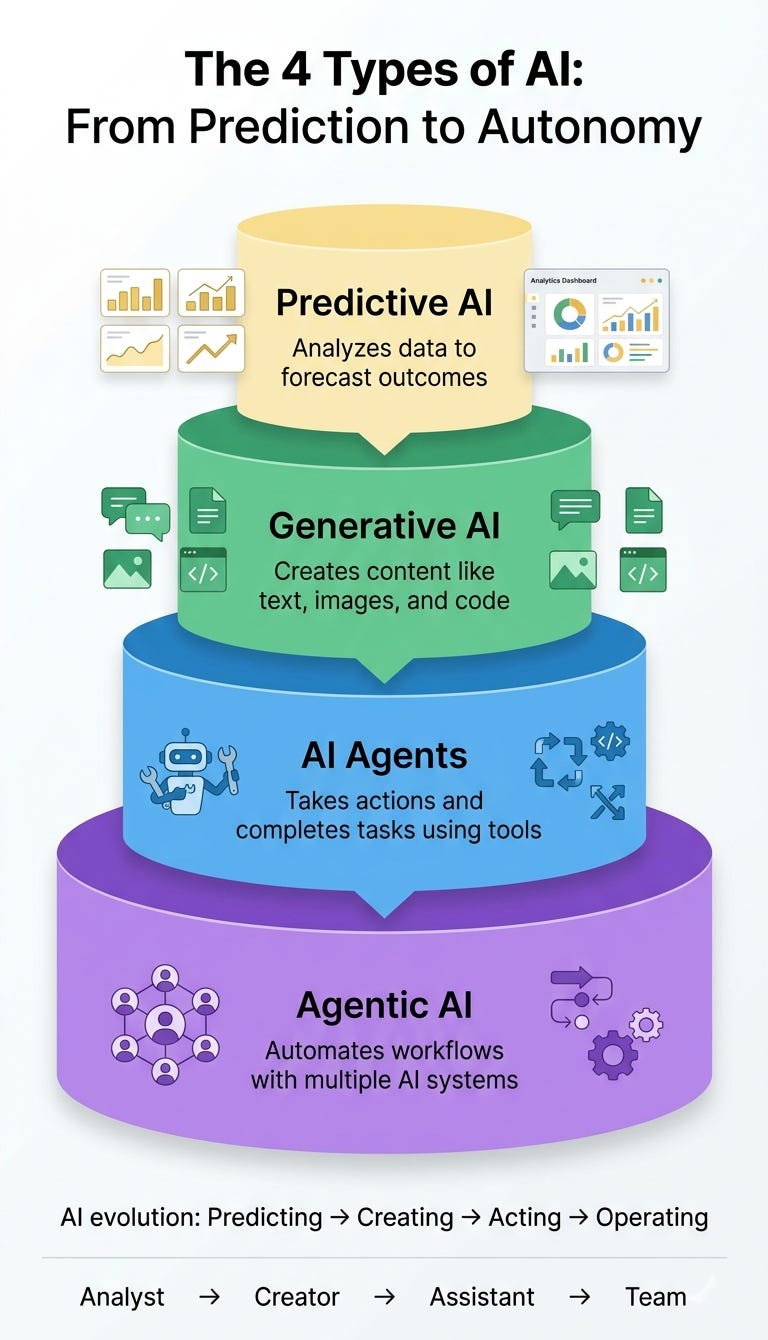
To understand this transformation, imagine AI as a four-level pyramid of intelligence:
Predictive AI
Generative AI
AI Agents
Agentic AI
Each layer builds on the previous one, moving from insight → creativity → action → autonomy.
Let’s break it down.
📊 Level 1: Predictive AI — The Data-Driven “Crystal Ball”
Predictive AI is the most mature and widely used form of AI today. It focuses on answering one key question:
👉 “What is likely to happen next?”
By analyzing historical data, predictive models identify patterns and forecast future outcomes.
🔍 What can it do?
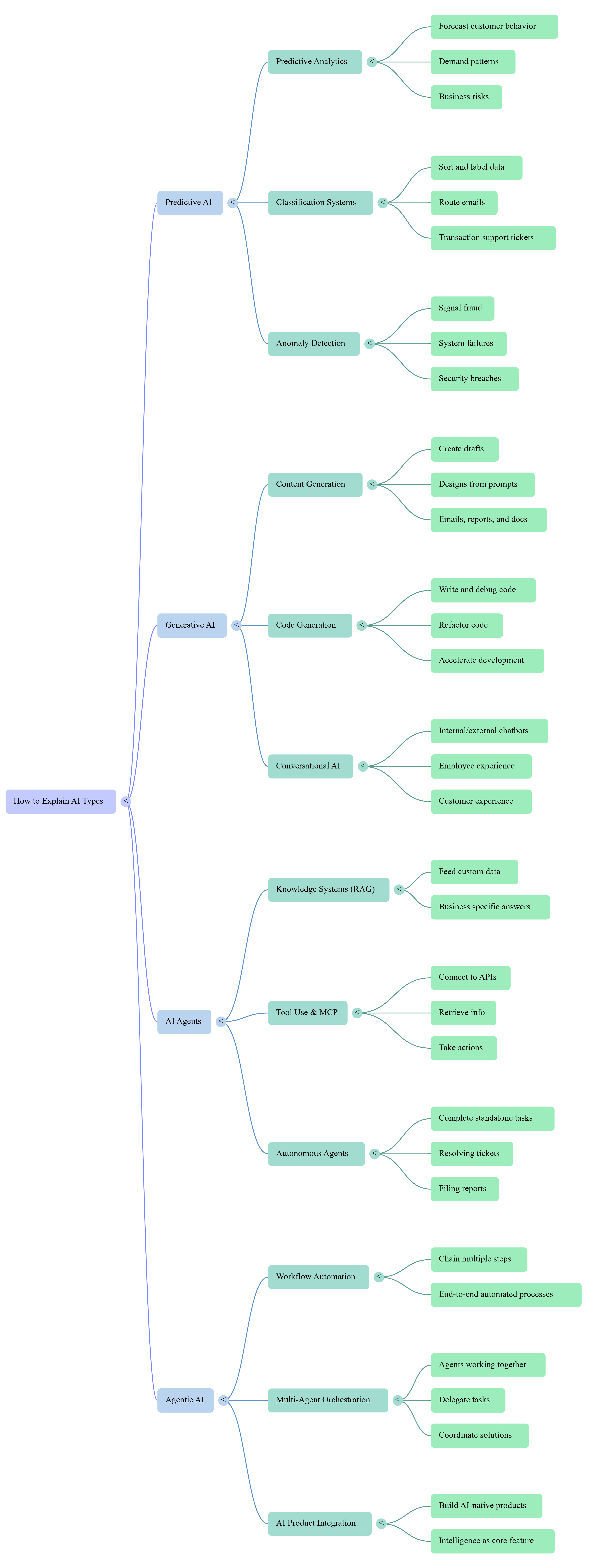
Forecast demand and sales trends
Predict customer behavior (like churn)
Detect fraud or system failures
⚙️ How it works
It relies on machine learning techniques such as:
Regression models
Decision trees
Classification algorithms
💡 Real-world example
Retail companies use predictive AI to anticipate demand spikes and adjust inventory before shortages happen.
🧠 Beyond prediction: Prescriptive AI
Modern systems go one step further:
Not just predicting outcomes
But recommending actions
For example: dynamically adjusting product prices based on demand forecasts.
🎨 Level 2: Generative AI — The Creative Powerhouse
Generative AI marks a major shift—from analyzing data to creating entirely new content.
👉 “What can we create?”
This is the technology behind tools like chatbots, image generators, and coding assistants.
✨ What can it generate?
Blog posts, emails, reports
Images and videos
Software code
Conversations
🛠️ Popular tools
Chatbots like ChatGPT, Claude
Image tools like Midjourney, Nano Banana
Coding assistants like GitHub Copilot, Claude Code
💡 Real-world impact
Marketing teams generate campaigns faster
Developers write code more efficiently
Businesses create personalized content at scale
⚠️ A note of caution
While powerful, over-reliance can reduce skill development—especially for beginners in technical fields.
🤖 Level 3: AI Agents — From Thinking to Doing
Now we move from creation to execution.
AI Agents are systems that don’t just respond—they act.
👉 “How do we get this done?”
🔄 What makes agents different?
Unlike generative AI (which needs prompts), agents:
Break down complex tasks
Make decisions
Use tools
Execute actions
🧩 Key components
Knowledge systems (RAG) → Access real-time data
Tool integration (MCP) → Connect to apps like Slack, Google Calendar
Reasoning engines → Plan and decide
💡 Example
An AI agent can:
Read emails
Schedule meetings
Update CRM systems
Generate reports
All automatically.
🔁 How they operate
Agents follow a loop:
Perceive
Think
Act
This makes them adaptable—even when situations change.
🧠 Level 4: Agentic AI — Fully Autonomous Systems
This is the most advanced stage of AI evolution.
👉 “What’s the goal—and how do we achieve it?”
Agentic AI doesn’t just execute tasks—it owns outcomes.
🚀 Key capabilities
End-to-end workflow automation
Independent decision-making
Multi-agent collaboration
💡 Real-world scenario
Imagine a supply chain system that:
Monitors weather, news, and traffic
Predicts delays
Reroutes shipments automatically
No human intervention needed.
🧑🤝🧑 Multi-agent systems
Complex goals are handled by teams of AI agents:
One plans
One executes
One reviews
Just like a human organization.
🏢 Enterprise AI Platforms: The Big Players
Businesses are rapidly adopting agentic systems through major platforms:
🔹 Salesforce Agentforce
Strong CRM integration
Best for sales & customer service
🔹 Microsoft Copilot Studio
Works across Microsoft 365
Ideal for general business workflows
🔹 Amazon Q
Focused on developers and AWS environments
🔹 No-code tools (Zapier, Stack AI)
Quick setup
Great for smaller teams
⚙️ Implementing AI: What Businesses Must Consider
Adopting advanced AI isn’t just about tools—it requires strategy.
📈 1. Data readiness
AI is only as good as your data:
Clean
Organized
Accessible
🔐 2. Security & ethics
Key risks include:
Data leaks
Prompt injection attacks
Misuse of autonomous systems
Solution:
Human-in-the-loop oversight
Strong governance frameworks
📜 3. Compliance
Organizations must align with regulations like:
GDPR
AI governance standards
🌍 The Future: AI-First Organizations
We’re heading toward a world where AI is not just a tool—but a core part of how businesses operate.
🔮 What this looks like:
AI handles repetitive and operational work
Humans focus on strategy and creativity
Organizations run on autonomous systems
🧠 The big shift
Predictive AI → Insight
Generative AI → Creativity
AI Agents → Execution
Agentic AI → Autonomy
🏁 Final Thoughts
AI is evolving from a passive assistant into an active participant in decision-making and execution.
The companies that succeed in this new era will be those that:
Understand the full AI stack
Integrate it strategically
Balance automation with human oversight
Because the future isn’t just about smarter tools—
👉 It’s about intelligent systems that act, adapt, and deliver outcomes.